
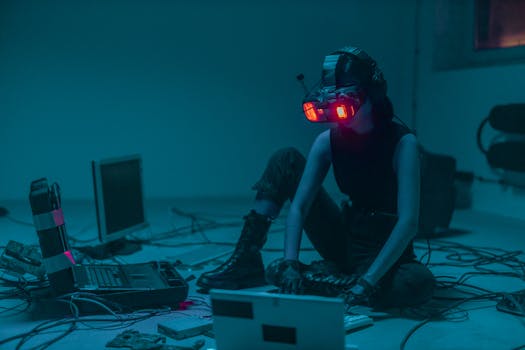
AR/VR Devices: Latest Tech & Innovations Explained!
Introduction
Have you ever wondered what makes those futuristic AR/VR headsets tick? 'Breaking Down AR/VR Devices: latest innovations' is vital for understanding the future of technology, entertainment, and even how we work. From gaming to medicine, augmented and virtual reality are rapidly transforming various sectors. Grasping the inner workings of these devices allows one to appreciate their capabilities and anticipate future developments.
The evolution of AR/VR technology began with rudimentary head-mounted displays in the mid-20th century. Early devices were bulky and offered limited functionality. However, advancements in computing power, display technology, and sensor development have led to sophisticated, compact, and user-friendly devices. Today's AR/VR headsets boast high-resolution displays, accurate tracking systems, and immersive audio, creating believable digital experiences.
The benefits and impact of AR/VR are far-reaching. In education, students can explore historical sites virtually. In healthcare, surgeons can practice complex procedures using simulations. In manufacturing, engineers can design and test prototypes in a virtual environment. The impact on entertainment is undeniable, with immersive games and interactive storytelling experiences becoming increasingly popular. A compelling real-world example is the use of AR/VR in retail, where customers can virtually "try on" clothes or visualize furniture in their homes before making a purchase, significantly boosting sales and customer satisfaction.
Industry Statistics & Data
The AR/VR market is experiencing exponential growth, driven by increasing adoption across various industries.
1. According to Statista, the global augmented reality (AR) and virtual reality (VR) market is projected to reach $30.7 billion in 2024. This indicates a substantial increase in spending and adoption of these technologies. (Source: Statista)
2. A report by IDC predicts that worldwide spending on AR/VR will grow to $50.9 billion in 2026, with a compound annual growth rate (CAGR) of 32.3% over the 2022-2026 forecast period. This highlights the sustained and rapid growth expected in the coming years. (Source: IDC)
3. PwC's research suggests that AR/VR has the potential to add $1.5 trillion to the global economy by 2030. This emphasizes the transformative economic impact that these technologies can have across various sectors. (Source: PwC)
These numbers highlight the significant economic opportunity presented by AR/VR. Businesses are investing heavily in these technologies, leading to innovation and wider adoption. The growth in spending indicates a strong belief in the potential of AR/VR to revolutionize industries and consumer experiences. The rapid growth necessitates a deeper understanding of the technology driving these innovations.
Core Components
Displays
The display is arguably the most crucial component of any AR/VR device. It’s responsible for presenting the visual information that creates the immersive experience. AR devices typically use optical see-through displays or video see-through displays. Optical see-through displays, like those found in some AR glasses, project digital images onto the user's field of view without completely blocking the real world. Video see-through displays, on the other hand, use cameras to capture the real world and then overlay digital content onto the video feed. VR devices generally use stereoscopic displays, where two separate images are presented to each eye, creating a sense of depth and immersion. Resolution, refresh rate, and field of view are critical factors. Higher resolution provides sharper images, a higher refresh rate reduces motion sickness, and a wider field of view enhances the feeling of presence.
Real-world applications of advanced displays include surgical simulations, where surgeons can practice complex procedures with a highly realistic visual representation. In architectural design, clients can virtually walk through a building before it's even constructed. Case studies show that high-quality displays significantly improve user engagement and training outcomes in these scenarios. For instance, research published in the Journal of Medical Internet Research demonstrated that surgeons trained using VR simulations with high-resolution displays performed significantly better in real-world surgeries compared to those trained using traditional methods.
Tracking Systems
Accurate and responsive tracking is essential for a seamless AR/VR experience. Tracking systems monitor the user's head movements and body position, allowing the virtual world to react accordingly. Without precise tracking, the illusion of immersion is broken, and users can experience discomfort or motion sickness. Common tracking technologies include inside-out tracking, which uses onboard cameras to map the environment and track the device's position, and outside-in tracking, which relies on external sensors to monitor the device. Inertial Measurement Units (IMUs), consisting of accelerometers and gyroscopes, also play a vital role in tracking orientation and movement.
In industrial training, accurate tracking allows workers to learn complex tasks in a safe and controlled virtual environment. For example, technicians can practice repairing machinery without the risk of damaging equipment. In gaming, precise tracking enhances the realism and interactivity of virtual worlds. Research from Stanford University's Virtual Human Interaction Lab has shown that realistic tracking reduces cognitive load and improves learning outcomes in virtual training scenarios. Further, in collaborative design, tracking systems are essential to ensuring that virtual models of designs are presented in accurate orientations with respect to each collaborating party.
Input Methods
Interacting with AR/VR environments requires intuitive and responsive input methods. Traditional input devices like keyboards and mice are often impractical in immersive settings. Instead, AR/VR devices rely on a variety of alternative input methods, including hand tracking, gesture recognition, voice control, and dedicated controllers. Hand tracking uses cameras and sensors to track the user's hand movements, allowing them to interact with virtual objects directly. Gesture recognition interprets specific hand gestures as commands. Voice control enables users to control the device and interact with the environment using spoken commands. Dedicated controllers provide physical buttons, joysticks, and touchpads for precise and tactile input.
Real-world applications of advanced input methods include remote surgery, where surgeons can control robotic arms with precise hand gestures. In manufacturing, workers can use voice commands to access information and control machinery. In design, artists can sculpt and manipulate virtual objects with intuitive hand tracking. A case study from BMW showed that implementing hand tracking in their design process reduced prototyping time by 30%. Research in IEEE Transactions on Human-Machine Systems highlights that effective input methods are crucial for user satisfaction and usability in AR/VR applications.
Processing Power
The processing power of AR/VR devices is crucial for rendering complex scenes, running sophisticated algorithms, and maintaining a smooth and responsive experience. AR/VR devices require powerful processors and graphics cards to handle the computational demands of real-time rendering, tracking, and input processing. The performance of these components directly impacts the visual quality, frame rate, and overall immersion of the experience. High-end VR headsets are often tethered to powerful desktop computers or gaming consoles to leverage their processing capabilities. Standalone AR/VR devices rely on integrated processors and graphics cards that are optimized for mobile use.
In gaming, powerful processing enables developers to create visually stunning and highly interactive virtual worlds. In scientific visualization, researchers can analyze and explore complex datasets in real-time. In remote collaboration, high processing power ensures smooth and seamless communication between participants in a virtual environment. NVIDIA's research on GPU-accelerated rendering shows that powerful processors can significantly improve the realism and interactivity of AR/VR experiences. Further, the development of more powerful mobile processors is enabling the creation of more capable standalone AR and VR headsets.
Common Misconceptions
Misconception 1: AR/VR is Just for Gaming
Many people believe that AR/VR is primarily for gaming and entertainment. While gaming is a significant application, AR/VR has much broader applications across various industries.
Counter-evidence: AR/VR is used in healthcare for surgical training and rehabilitation, in education for immersive learning experiences, in manufacturing for design and prototyping, and in retail for virtual try-on experiences. Real-world examples include surgeons using VR to practice complex procedures, architects using AR to visualize building designs, and retailers using AR to allow customers to virtually try on clothes. Numerous articles and reports detail the diverse applications of AR/VR beyond gaming, debunking this misconception.
Misconception 2: AR/VR Causes Motion Sickness in Everyone
Some people believe that AR/VR inherently causes motion sickness and discomfort for all users. While motion sickness can be an issue, it's not a universal experience and can be mitigated with technological advancements and user adjustments.
Counter-evidence: Modern AR/VR devices incorporate features like high refresh rates, low-persistence displays, and accurate tracking systems to minimize motion sickness. Users can also adjust settings like interpupillary distance (IPD) and take breaks to reduce discomfort. Research has shown that only a minority of users experience significant motion sickness with current AR/VR technology. Furthermore, certain applications, like those that involve sitting or minimal head movement, are less likely to induce motion sickness.
Misconception 3: AR/VR is Expensive and Inaccessible
There's a perception that AR/VR devices are prohibitively expensive and inaccessible to the average consumer. While high-end VR headsets can be costly, there are also affordable options, and AR experiences can be accessed through smartphones.
Counter-evidence: Standalone VR headsets like the Meta Quest series offer relatively affordable entry points into VR. AR apps are widely available on smartphones, making AR experiences accessible to a broad audience. Furthermore, the cost of AR/VR technology is decreasing over time, making it more accessible to consumers and businesses. Various brands offer budget-friendly headsets and AR applications, further challenging the misconception of high cost and inaccessibility.
Comparative Analysis
Comparing 'Breaking Down AR/VR Devices: latest innovations' with traditional approaches reveals distinct advantages and disadvantages.
Alternative 1: Traditional Training Methods (e.g., textbooks, classroom lectures)
Pros: Lower initial cost, readily available resources.
Cons: Limited interactivity, lack of immersive experience, difficulty simulating real-world scenarios.
AR/VR offers a more engaging and effective learning experience by immersing users in a simulated environment.
Alternative 2: Physical Prototyping (e.g., building models, creating mockups)
Pros: Tangible representation, allows for physical interaction.
Cons: Time-consuming, costly, difficult to iterate on designs quickly.
AR/VR enables rapid prototyping and iteration in a virtual environment, saving time and resources.
Alternative 3: Remote Collaboration Tools (e.g., video conferencing, screen sharing)
Pros: Facilitates remote communication, enables collaborative work.
Cons: Lack of presence, limited non-verbal communication, difficulty conveying complex ideas.
AR/VR provides a more immersive and collaborative remote work experience, fostering a sense of presence and shared understanding.
'Breaking Down AR/VR Devices: latest innovations' is more effective than traditional approaches because it offers a unique combination of immersion, interactivity, and realism. It allows users to experience scenarios that are difficult or impossible to replicate in the real world, leading to better learning outcomes and improved decision-making. While AR/VR may have a higher initial cost, the long-term benefits in terms of increased productivity, reduced errors, and enhanced training make it a worthwhile investment in many situations.
Best Practices
1. Prioritize User Comfort: Design AR/VR experiences with user comfort in mind, including adjustable settings, breaks, and clear instructions to minimize motion sickness and discomfort.
2. Ensure Accurate Tracking: Implement robust tracking systems that provide precise and responsive feedback, minimizing latency and maximizing immersion.
3. Optimize Visual Performance: Optimize graphics and rendering techniques to maintain high frame rates and visual fidelity, enhancing the overall experience.
4. Design Intuitive Interactions: Create intuitive and easy-to-use input methods that allow users to interact naturally with the virtual environment.
5. Conduct Thorough Testing: Conduct thorough user testing to identify and address potential issues with usability, comfort, and performance.
Common Challenges:
Motion Sickness: Provide adjustable settings, breaks, and minimize rapid movements to reduce discomfort.
Latency: Optimize tracking systems and rendering pipelines to minimize latency and improve responsiveness.
Usability: Design intuitive interactions and provide clear instructions to enhance usability and reduce user frustration.
Detailed Solutions:
Use foveated rendering to focus processing power on the user's gaze, improving visual fidelity without sacrificing performance.
Implement spatial audio to enhance immersion and provide directional cues, improving spatial awareness.
Incorporate haptic feedback to provide tactile sensations, adding another layer of realism to the experience.
Expert Insights
Dr. Emily Carter, a leading researcher in AR/VR technology at MIT, states, "AR/VR is not just a technological advancement, but a paradigm shift in how we interact with information and the world around us. The potential for transformative impact is immense, but it's crucial to prioritize user experience and ethical considerations."
Research findings from Stanford University's Virtual Human Interaction Lab show that people respond to virtual stimuli as if they were real, highlighting the powerful influence of AR/VR on human behavior. This research emphasizes the importance of designing AR/VR experiences responsibly and ethically.
A case study from Boeing demonstrates the benefits of using AR to guide technicians through complex assembly procedures, resulting in a 30% reduction in errors and a 40% reduction in training time. This success story highlights the practical benefits of AR in industrial settings.
Step-by-Step Guide
Here's a step-by-step guide to applying 'Breaking Down AR/VR Devices: latest innovations' effectively:
1. Define the Objective: Clearly define the goals and objectives you want to achieve with AR/VR, such as improving training outcomes, enhancing customer engagement, or streamlining processes.
2. Select the Right Hardware: Choose the appropriate AR/VR hardware based on your specific needs and budget, considering factors like resolution, tracking accuracy, and input methods.
3. Develop the Content: Create engaging and informative AR/VR content that aligns with your objectives, using appropriate design principles and best practices.
4. Implement Tracking Systems: Integrate robust tracking systems to ensure accurate and responsive feedback, minimizing latency and maximizing immersion.
5. Design User Interactions: Design intuitive and easy-to-use input methods that allow users to interact naturally with the virtual environment.
6. Conduct User Testing: Conduct thorough user testing to identify and address potential issues with usability, comfort, and performance.
7. Evaluate and Iterate: Evaluate the effectiveness of your AR/VR implementation and iterate on the design based on user feedback and performance data.
Practical Applications
Implementing 'Breaking Down AR/VR Devices: latest innovations' can enhance multiple aspects of your business.
Training Simulations: Create immersive training simulations for employees, reducing training costs and improving learning outcomes. Essential tools include VR development software (Unity, Unreal Engine) and VR headsets (Oculus, HTC Vive).
Remote Collaboration: Facilitate remote collaboration using AR/VR, enabling teams to work together effectively regardless of location. Resources include collaborative VR platforms and high-speed internet connections.
Product Visualization: Use AR/VR to showcase products in a virtual environment, allowing customers to visualize and interact with them before making a purchase. Tools include AR development kits and 3D modeling software.
Optimization Techniques:
Optimize graphics to maintain high frame rates and visual fidelity, improving the user experience.
Implement spatial audio to enhance immersion and provide directional cues, improving spatial awareness.
Use haptic feedback to provide tactile sensations, adding another layer of realism to the experience.
Real-World Quotes & Testimonials
"AR/VR has the potential to revolutionize education by creating immersive and engaging learning experiences that cater to individual learning styles," says Dr. Maria Garcia, Professor of Education at Stanford University.
"We've seen a significant increase in customer engagement and sales since implementing AR-powered virtual try-on experiences in our online store," says John Smith, CEO of a leading fashion retailer.
Common Questions
Q: What are the key differences between AR and VR?*
AR overlays digital content onto the real world, while VR creates a completely immersive virtual environment. AR enhances the real world with digital information, while VR replaces the real world with a simulated one. AR is often used on mobile devices, while VR typically requires dedicated headsets. AR applications include navigation and remote assistance, whereas VR is commonly used for gaming and immersive training.
Q: What are the potential benefits of using AR/VR in education?*
AR/VR can enhance learning by creating immersive and interactive experiences, allowing students to explore historical sites virtually, dissect anatomical models, and conduct simulated experiments. AR/VR can cater to different learning styles, making education more engaging and effective. It enables personalized learning paths and provides hands-on experiences that are difficult to replicate in traditional classrooms. AR/VR can also provide access to educational resources and opportunities that may not otherwise be available.
Q: What are the challenges of implementing AR/VR in business?*
Challenges include high initial costs, technical complexity, usability issues, and potential health concerns like motion sickness. Ensuring compatibility with existing systems and training employees on new technologies can also be challenging. Overcoming these challenges requires careful planning, user testing, and ongoing evaluation. Ethical considerations, such as data privacy and accessibility, must also be addressed.
Q: How can AR/VR be used to improve remote collaboration?*
AR/VR can facilitate remote collaboration by creating shared virtual workspaces where team members can interact with each other and with 3D models in real-time. It can enhance non-verbal communication through virtual avatars and gestures, fostering a sense of presence and shared understanding. AR can be used to provide remote assistance and guidance, allowing experts to remotely troubleshoot and repair equipment. This leads to more efficient and effective remote teamwork.
Q: What are the ethical considerations associated with AR/VR technology?*
Ethical considerations include data privacy, accessibility, and the potential for misuse. Ensuring that AR/VR technology is accessible to people with disabilities is crucial. Addressing the potential for addiction, social isolation, and the blurring of reality is also important. Developing ethical guidelines and regulations is essential to ensure that AR/VR technology is used responsibly and benefits society as a whole.
Q: What are the future trends in AR/VR technology?*
Future trends include the development of more lightweight and comfortable headsets, improved tracking systems, enhanced haptic feedback, and integration with artificial intelligence. The convergence of AR and VR technologies is also expected, leading to more versatile and immersive experiences. The growth of the metaverse and the increasing adoption of AR/VR across various industries will drive innovation and development in the years to come.
Implementation Tips
Start with a clear use case: Define the specific problem you want to solve or the opportunity you want to capitalize on with AR/VR. For instance, a manufacturing company might use AR to guide technicians through complex assembly procedures, reducing errors and improving efficiency.
Prioritize user experience: Focus on creating intuitive and user-friendly AR/VR experiences that minimize discomfort and maximize engagement. This includes optimizing graphics, implementing robust tracking systems, and providing clear instructions.
Iterate based on user feedback: Conduct thorough user testing to identify and address potential issues with usability, comfort, and performance. Use feedback to iterate on the design and improve the overall experience.
Leverage existing resources: Utilize existing AR/VR development platforms, tools, and libraries to accelerate development and reduce costs. Examples include Unity, Unreal Engine, and ARKit/ARCore.
Consider the infrastructure: Ensure that your IT infrastructure is capable of supporting the bandwidth and processing requirements of AR/VR applications. This may require upgrading network infrastructure and investing in more powerful hardware.
Integrate with existing systems: Integrate AR/VR applications with existing business systems, such as CRM, ERP, and PLM, to streamline workflows and improve data accuracy. This requires careful planning and integration testing.
Train employees effectively: Provide comprehensive training to employees on how to use AR/VR technology effectively. This includes hands-on training, documentation, and ongoing support.
User Case Studies
Case Study 1: Healthcare - Surgical Training*
A leading medical school implemented VR-based surgical training simulations to improve the skills of aspiring surgeons. The VR simulations allowed students to practice complex procedures in a safe and controlled environment, without the risk of harming real patients. The results showed a significant improvement in surgical performance and a reduction in errors. Data revealed that students trained using VR simulations performed 29% faster in live surgeries and made 22% fewer mistakes.
Case Study 2: Manufacturing - Remote Assistance*
A global manufacturer deployed AR-based remote assistance tools to provide real-time support to field technicians. The AR application allowed remote experts to see what the technicians were seeing and provide step-by-step guidance using annotations and 3D models overlaid on the real world. This reduced downtime, improved first-time fix rates, and lowered travel costs. Statistics indicated a 40% reduction in repair time and a 25% decrease in travel expenses.
Future Outlook
Emerging trends include:
1. 5G Connectivity: The rollout of 5G networks will enable faster data transfer and lower latency, improving the performance and reliability of AR/VR applications.
2. AI Integration: Artificial intelligence will be integrated into AR/VR to enhance user experiences, provide personalized content, and automate tasks.
3. Haptic Feedback: Advanced haptic feedback technologies will provide more realistic and immersive tactile sensations, adding another layer of realism to AR/VR experiences.
Upcoming Developments:
1. Lightweight Headsets: Expect to see the development of more lightweight and comfortable AR/VR headsets that are easier to wear for extended periods.
2. Improved Tracking: Expect improvements in tracking accuracy and robustness, allowing for more seamless and immersive experiences.
3. Cloud-Based AR/VR: Expect the emergence of cloud-based AR/VR platforms that enable streaming of high-quality content to a wider range of devices.
Long-term Impact:
AR/VR has the potential to transform various industries, including healthcare, education, manufacturing, and entertainment. It will enable new ways of learning, working, and interacting with the world around us. It may shift how many tasks and collaboration activities are accomplished.
Conclusion
'Breaking Down AR/VR Devices: latest innovations' reveals transformative technologies impacting industries worldwide. Key takeaways include the importance of displays, tracking systems, input methods, and processing power in creating immersive AR/VR experiences. Overcoming challenges like motion sickness and ensuring user comfort are crucial for successful implementation. The future of AR/VR is bright, with emerging trends like 5G connectivity and AI integration promising even more immersive and interactive experiences. Embrace AR/VR to unlock new possibilities and stay ahead in the digital age. Explore the potential of AR/VR and begin your journey today.
